

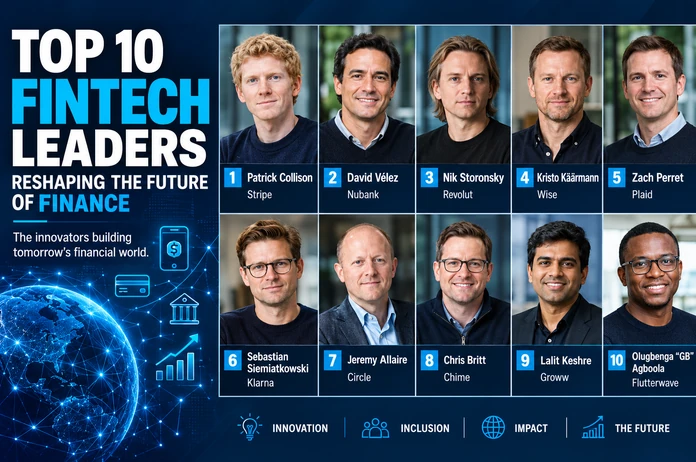
Fintech is changing how people send money, manage bank accounts, invest, borrow, and run businesses. Digital banking apps have made everyday financial services more accessible, while payment platforms, financial data networks, and artificial intelligence are creating new ways for companies to handle money.
Behind these changes are leaders who make strategic decisions, develop new products, and guide financial technology companies through increasingly competitive markets. Resource Magazines has discussed those 10 fintech leaders and their vision.
Table of Contents
1. Patrick Collison – Stripe
Patrick Collison is the co-founder and CEO of Stripe. The company builds technology that helps businesses accept payments, manage subscriptions, prevent fraud, and operate online financial services.
Stripe has become an important part of the infrastructure behind internet commerce. Rather than requiring every business to develop its own payment systems, Stripe provides tools that companies can integrate into their websites, applications, and business platforms.
The scale of this infrastructure is significant. In its 2025 annual update, Stripe reported that businesses using its platform processed $1.9 trillion in total payment volume. A 34% increase from the previous year. The company also highlighted its work on programmable financial services and commerce involving artificial intelligence.
2. David Vélez – Nubank
David Vélez is the founder and CEO of Nubank. He founded the business after encountering difficulties navigating Brazil’s traditional banking system. Nubank launched in 2013 with a digital-first approach designed to make financial services easier to access and use.
Traditional banking can involve physical branches, complicated processes, and fees that customers may struggle to understand. Nubank built its service around a mobile experience, allowing customers to manage many everyday financial activities through an app.
The company has expanded beyond its original credit-card offering into a broader financial ecosystem. Its services and markets have grown across Latin America, particularly Brazil, Mexico, and Colombia. Nubank reported that it had reached 135 million customers in May 2026.
3. Nik Storonsky – Revolut
Nik Storonsky is the co-founder and CEO of Revolut. The company began with a focus on making international spending and money transfers more convenient, then expanded into a broader range of financial products.
Revolut’s model brings several financial functions into one digital platform. Depending on the market and the products available there, customers may be able to manage payments, exchange currencies, hold money, access cards, and use additional financial services through the same app.
This integrated approach creates an opportunity to compete for more of a customer’s everyday financial activity. It also brings operational challenges: a company serving multiple countries must navigate different regulatory requirements, local payment systems, customer expectations, and licensing arrangements.
In March 2026, Revolut announced that it had applied for a U.S. national bank charter and named Cetin Duransoy as its U.S. CEO. The announcement reflected the company’s ambition to expand its banking presence in the American market.
4. Kristo Käärmann – Wise
Kristo Käärmann co-founded Wise to address the complexity and cost of moving money between countries. He continues to serve as its CEO. International payments have traditionally involved multiple banks, intermediary institutions, exchange-rate markups, and transfer fees. Wise aims to make international money movement more transparent by showing customers its fees and exchange rates before they send money.
The company has expanded its services beyond transfers. Customers can use Wise accounts and cards in supported markets, while banks and other businesses can access its payment infrastructure through Wise Platform.
Wise’s financial year 2026 results provide evidence of the scale of its operations. The company reported 18.9 million active customers and $243.5 billion in cross-border payment volume, an increase of 31% compared with the previous financial year. It also reported that 75% of its global payments in the fourth quarter were completed in under 20 seconds.
5. Zach Perret – Plaid
Zach Perret is the co-founder and CEO of Plaid. Plaid provides technology that helps consumers connect financial accounts to applications and services they choose to use.
For example, a budgeting app may need permission to access transaction information from a customer’s bank account. A lending platform may need financial data to help evaluate an application. Plaid provides connectivity tools that support these kinds of digital experiences.
The company says its technology supports more than 12,000 financial institutions and more than 9,000 fintech services.
6. Sebastian Siemiatkowski – Klarna
Sebastian Siemiatkowski is the co-founder and CEO of Klarna. Klarna became widely known for offering flexible payment options at online checkout and has expanded into a broader digital financial and shopping platform.
Flexible payment services can give customers additional ways to pay for purchases, while helping retailers offer alternative checkout experiences. Klarna has also developed services connected with shopping, payments, and banking.
The business operates at the intersection of finance and e-commerce. Its technology can influence how customers complete purchases, how retailers manage payments, and how consumers interact with financial products during the shopping process.
Klarna’s investor relations information reports more than 120 million active consumers and operations across 26 countries. The company is publicly listed on the New York Stock Exchange.
7. Jeremy Allaire – Circle
Jeremy Allaire is the co-founder, CEO, and chairman of Circle. Circle is known for its work with USDC, a stablecoin designed to maintain a value of one U.S. dollar.
Unlike cryptocurrencies whose market prices can fluctuate significantly, a dollar-pegged stablecoin is designed to track the value of the dollar. Its value and reliability nevertheless depend on the quality of its backing arrangements, redemption processes, market infrastructure, and applicable regulatory safeguards.
Stablecoins can support the transfer of digital value across blockchain networks. Potential applications include international payments, digital asset settlement, and financial services that operate around the clock. Their practical usefulness depends on factors such as fees, liquidity, acceptance, and compliance requirements.
Circle’s leadership page identifies Allaire as its co-founder, CEO, and chairman, responsible for the company’s strategy and operating execution. In 2026, he was also named to TIME’s list of the 100 most influential people.
8. Chris Britt – Chime
Chris Britt is the co-founder and CEO of Chime. Chime focuses on providing consumer financial services through a technology-driven model rather than relying on a traditional branch network.
Its approach emphasizes digital account access, payments, and everyday money management. This model can reduce some of the friction associated with traditional banking, although the exact services and account arrangements depend on the applicable product terms and partner institutions. Chime’s official leadership information confirms Britt’s role as CEO and co-founder.
A major development came in September 2026, when Chime announced an agreement to acquire Stride Bank for $590 million in cash. The transaction was expected to close in the first half of 2027, subject to regulatory approvals and other conditions. Chime said the acquisition would support its ambition to bring more of its banking infrastructure in-house.
The announcement is significant because it illustrates a possible shift in how digital financial companies operate. A fintech that initially relies on partner banks may eventually seek greater control over the underlying infrastructure supporting its products.
9. Lalit Keshre – Groww
Lalit Keshre is the co-founder and CEO of Groww. Groww provides digital tools that help customers access investment products and manage their investing activities.
Investment platforms can make financial markets easier to access by simplifying account setup, presenting investment information through digital interfaces, and allowing users to manage transactions online. But easy access does not guarantee investment success, and customers still face market risk. Groww’s leadership information lists Keshre as a whole-time director and CEO.
Keshre’s leadership makes Groww relevant to the broader fintech trend of moving investment access from traditional intermediaries toward digital platforms.
10. Olugbenga “GB” Agboola – Flutterwave
Olugbenga “GB” Agboola is the founder and CEO of Flutterwave. The company develops payment infrastructure that helps businesses accept and process payments across markets.
Payments can be particularly challenging for businesses operating across multiple countries, where payment methods, currencies, banking systems, and regulatory requirements differ. A company that provides connections between these systems can help merchants reach customers through more convenient payment options.
Agboola’s background includes technology and financial services, and his current role at Flutterwave is also listed in material from the United Nations Conference on Trade and Development’s World Investment Forum.
Final Thoughts
The top fintech leaders reshaping the industry in 2026 are working on different parts of the financial system. Patrick Collison focuses on payments infrastructure, David Vélez has expanded digital banking across Latin America, Kristo Käärmann is changing cross-border money movement, and Zach Perret’s company helps connect financial accounts to digital services. Other leaders are developing flexible payment platforms, stablecoin infrastructure, consumer banking technology, investing services, and cross-border payment networks.
There is no single measure that makes one executive the most influential fintech leader. The strongest way to assess their impact is to examine their current roles, the products their companies build, the scale of their operations, and the problems those products aim to solve.
As fintech continues to evolve, the industry’s future will depend not only on faster technology and wider access, but also on trust, responsible innovation, strong security, and the ability to deliver reliable financial services to customers around the world.
Frequently Asked Questions
Who are the top fintech leaders in 2026?
Influential fintech leaders include Patrick Collison of Stripe, David Vélez of Nubank, Nik Storonsky of Revolut, Kristo Käärmann of Wise, Zach Perret of Plaid, Sebastian Siemiatkowski of Klarna, Jeremy Allaire of Circle, Chris Britt of Chime, Lalit Keshre of Groww, and Olugbenga Agboola of Flutterwave. This is an editorial selection rather than a definitive industry ranking.
What is fintech?
Fintech, short for financial technology, refers to technology used to deliver, improve, or support financial services.
How are fintech companies changing banking?
Fintech companies use digital platforms to simplify account access, payments, transfers, and financial management. Some compete directly with traditional banks, while others provide technology and infrastructure that banks and other financial institutions use.
Why is artificial intelligence important in fintech?
AI can support tasks such as fraud detection, customer service, financial data analysis, and process automation.
What is the difference between fintech and traditional banking?
Traditional banks often operate through established banking infrastructure and may offer branch-based services alongside digital products. Fintech companies generally emphasize technology-driven financial experiences, although some are licensed banks and others work with regulated banking partners. The distinction depends on the company’s business model and legal status.