

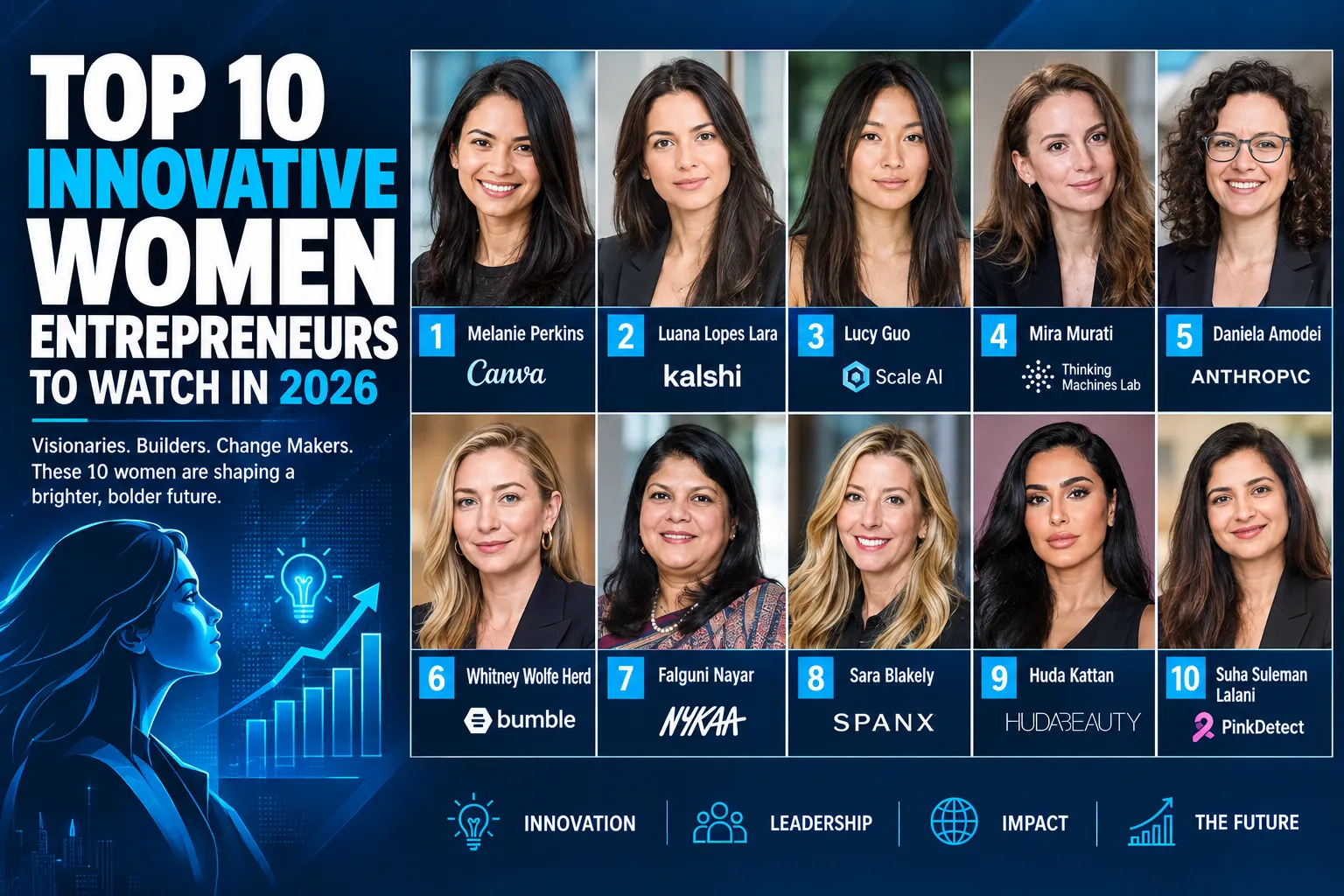
Innovation is changing how people work, shop, communicate, manage money, and access healthcare. Behind many of these changes are women entrepreneurs who have identified problems, challenged traditional business models, and built companies around new ideas.
Table of Contents
In 2026, women founders are making their mark across artificial intelligence (AI), software, digital finance, beauty, healthcare, and consumer products. Some are expanding established businesses into new markets, while others are developing emerging technologies that could transform entire industries. Resource Magazines explores 10 innovative women entrepreneurs to watch in 2026, highlighting their businesses, achievements, and the ideas that make their work noteworthy.
1. Melanie Perkins – CEO of Canva
Melanie Perkins is the co-founder and CEO of Canva, the Australian technology company that has helped make graphic design more accessible to people without professional design experience.
Before Canva, creating polished presentations, marketing materials, social media graphics, and other visual content often required specialised software and design skills. Perkins recognised an opportunity to simplify this process by building a platform that allowed people to create professional-looking designs through an intuitive interface.
Launched in 2013, Canva grew from a straightforward design tool into a broader visual communication platform. Individuals, educators, small businesses, and large organisations now use software of this kind to produce a wide range of digital content.
2. Luana Lopes Lara – Co-founder of Kalshi
Luana Lopes Lara is the co-founder of Kalshi, a financial exchange that allows eligible users to trade contracts linked to the outcomes of specific events. The idea behind prediction markets is to create a marketplace where participants can express views about future events through financial contracts. Depending on the market and its rules, those events may relate to economic indicators, politics, sports, or other publicly defined outcomes.
Kalshi operates in a regulated financial environment in the United States. Its model has attracted attention as prediction markets have become more visible to consumers, investors, and policymakers. Lopes Lara’s background is also unusual. Before becoming an entrepreneur, she trained as a professional ballet dancer and studied at the Massachusetts Institute of Technology. Her career demonstrates how founders can combine experiences from different fields when developing a business idea.
3. Lucy Guo – Founder of Scale AI
Lucy Guo is a technology entrepreneur and co-founder of Scale AI, a company that became an important part of the data infrastructure ecosystem supporting artificial intelligence.
AI systems depend on large amounts of organised, labelled, and carefully prepared data. Companies such as Scale AI have helped businesses and institutions develop the datasets and related services required to train and evaluate AI models.
Guo later founded Passes, a platform focused on helping creators connect with their audiences and generate revenue from their content and communities.
Her work reflects two significant areas of digital business: the infrastructure behind AI and the tools that help online creators build sustainable businesses.
4. Mira Murati – Turning AI Research Into Products
Mira Murati is an engineer and technology entrepreneur known for her work in artificial intelligence. She previously held senior leadership positions at OpenAI, where she was involved in the development and deployment of AI products.
After leaving OpenAI, Murati founded Thinking Machines Lab, a company focused on advancing AI systems and making them more useful, capable, and adaptable.
Her work sits in a highly competitive field where researchers and businesses are trying to develop models that can reason, generate content, support complex tasks, and work alongside people.
5. Daniela Amodei – Developing AI With a Focus on Reliability
Daniela Amodei is the co-founder and president of Anthropic, an AI company known for developing the Claude family of AI models.
Anthropic operates in a fast-moving industry where companies compete to create useful AI assistants and enterprise tools. Its work has also brought attention to questions about AI safety, model behaviour, and how powerful systems should be developed and deployed.
Amodei’s career reflects the growing importance of combining technical development with business operations, research, and organisational leadership.
6. Whitney Wolfe Herd – Rethinking Online Dating
Whitney Wolfe Herd founded Bumble in 2014 with a different approach to online dating. The app initially stood out by giving women control over initiating conversations in heterosexual matches.
The idea challenged the conventional design of dating platforms and helped Bumble develop a recognisable position in a crowded market. The company later expanded into related areas of social connection and networking.
Wolfe Herd’s entrepreneurial story illustrates how changing one important part of a familiar service can create a distinct business identity.
7. Falguni Nayar – Nykaa Founder
Falguni Nayar is the founder of Nykaa, an Indian beauty and lifestyle retailer that built its business around online shopping, product discovery, and a broad range of beauty brands.
Before launching Nykaa, Nayar spent many years working in investment banking. She entered entrepreneurship later in her career, using her business experience to identify an opportunity in India’s developing online retail market.
Beauty customers often need more than a product catalogue. They want information about ingredients, product suitability, trusted brands, and how different items compare. Nykaa built its retail experience around these needs while developing a wider presence in beauty and lifestyle products.
8. Sara Blakely – Spanx Founder
Sara Blakely founded Spanx after identifying a practical problem with traditional women’s clothing. She wanted a product that could create a smoother appearance under clothing without the limitations of existing options.
She developed her idea with personal savings and built a business around a product that addressed a clear consumer need. Spanx grew into a recognised shapewear brand, demonstrating the commercial potential of improving an everyday product.
Blakely later expanded into new ideas, including Sneex, a footwear brand that combines the appearance of high heels with elements inspired by sneakers.
9. Huda Kattan – Founder of Huda Beauty
Huda Kattan is a beauty entrepreneur and the founder of Huda Beauty. She initially built an audience through beauty content and makeup tutorials before developing a cosmetics business.
Her path reflects the growing connection between content creation and consumer products. Rather than relying only on traditional advertising, beauty brands can use tutorials, customer feedback, demonstrations, and online communities to build awareness and trust.
Kattan’s brand grew in a market where customers often look for products they have seen demonstrated by people whose expertise or style they admire.
10. Suha Suleman Lalani – CEO of PinkDetect
Suha Suleman Lalani is the founder of PinkDetect, a healthcare technology company focused on helping improve breast cancer detection.
Healthcare innovation can have a particularly direct impact on people’s lives. Better access to screening, more efficient workflows, and tools that support clinical decisions may help healthcare providers identify problems and guide patients toward appropriate care.
PinkDetect has attracted attention for its AI-powered approach to expanding access to earlier breast cancer detection. Inc.’s 2026 Female Founders profile highlighted the company’s ambition to extend its reach to more women through an AI-powered platform.
What Makes These Women Entrepreneurs Matters?
Although these entrepreneurs work in different industries, their businesses reveal several shared approaches to innovation. Many successful businesses begin with a clear customer problem. These Founders have bought the solution for those problems. AI, digital platforms, and online commerce are changing how companies deliver products and services. Entrepreneurs who use technology to reduce friction, improve access, or make complex tasks easier may gain an advantage.
Businesses that communicate honestly and deliver consistently are better positioned to develop long-term customer relationships.Entrepreneurs must continually assess whether their products remain relevant and whether new opportunities align with their customers’ needs.
The women in this list also demonstrate that entrepreneurship can begin at different career stages. Their experiences offer useful lessons for aspiring founders regardless of age, industry, or background.
Frequently Asked Questions
Who are the most innovative women entrepreneurs to watch in 2026?
Notable entrepreneurs include Melanie Perkins of Canva, Luana Lopes Lara of Kalshi, Lucy Guo of Passes, Mira Murati of Thinking Machines Lab, Daniela Amodei of Anthropic, Whitney Wolfe Herd of Bumble, Falguni Nayar of Nykaa, Sara Blakely of Spanx and Sneex, Huda Kattan of Huda Beauty, and Suha Suleman Lalani of PinkDetect. They work across technology, finance, retail, beauty, and healthcare.
What industries offer opportunities for women entrepreneurs in 2026?
AI, healthcare technology, digital commerce, financial technology, education, sustainability, and consumer products all offer opportunities. The strongest business ideas generally address a clear customer need and have a realistic plan for reaching and serving their intended market.
How can women start a business with limited funding?
Aspiring founders can begin by researching their target market, testing a small version of their product or service, and gathering feedback before making major investments. Depending on the business, they may also explore bootstrapping, grants, accelerators, crowdfunding, or suitable investment opportunities.
Why is innovation important for entrepreneurs?
Innovation helps businesses solve problems, improve customer experiences, differentiate themselves from competitors, and respond to changing markets. It can involve a new technology, but it can also mean improving an existing product, simplifying a service, or creating a better way to reach customers.
Do women entrepreneurs need a technology background to build an innovative business?
No. Technical knowledge can be valuable in some industries, but innovation can also come from understanding customers, improving operations, developing products, or identifying gaps in a market. Founders can build teams or work with specialists when their business requires expertise they do not personally possess.
How were these 10 women selected?
This is an editorial selection based on the founders’ business activities, approaches to innovation, industry relevance, and potential areas of continued development in 2026. It is not a formal ranking, and inclusion does not guarantee future commercial success.