

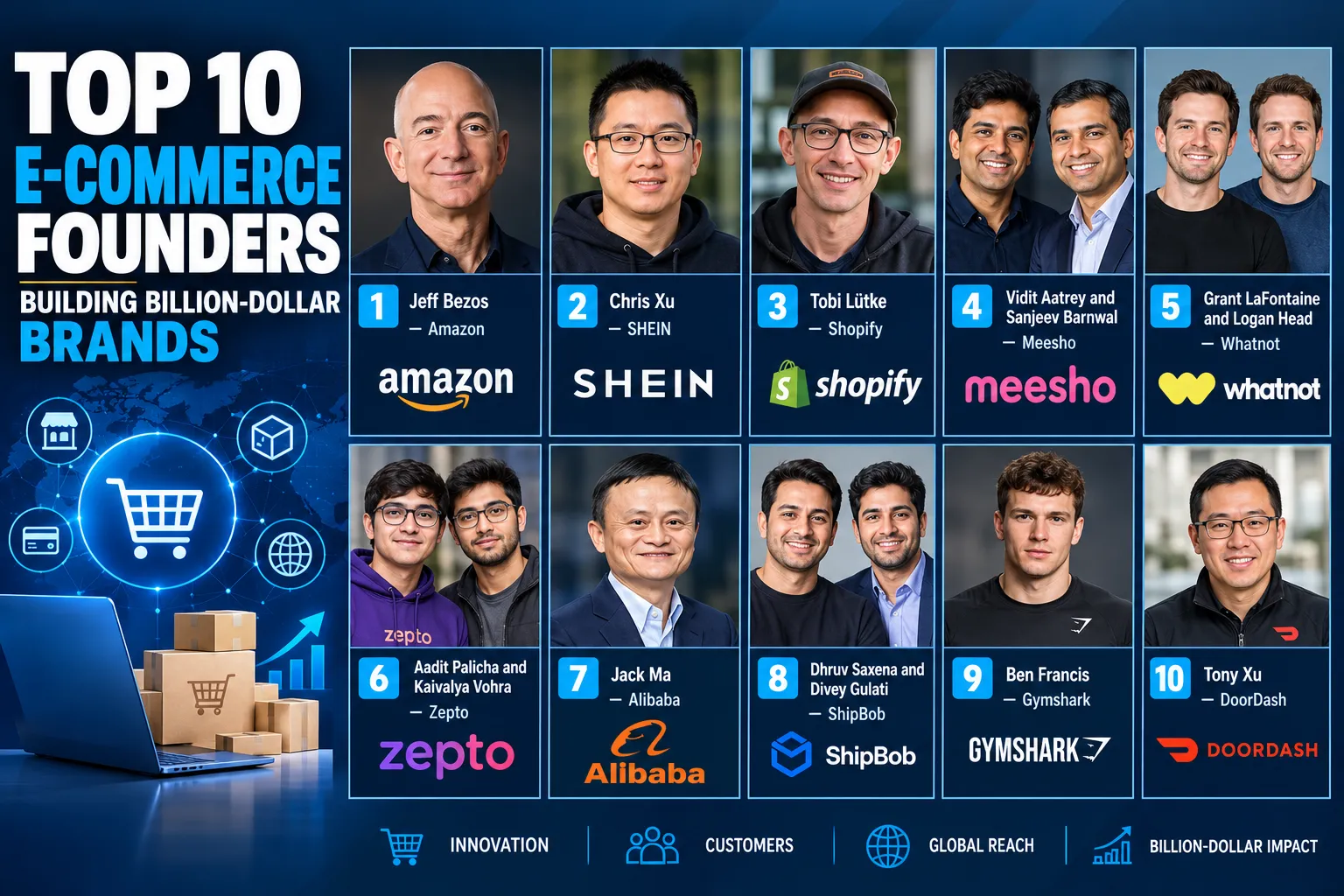
Online shopping has changed how people discover products, compare prices, and buy almost everything from clothing to groceries. What once required visiting several stores can now happen through a website or mobile app in just a few minutes.
Behind this transformation are entrepreneurs who recognized the potential of digital commerce and built businesses around convenience, technology, customer experience, and scale. Some created global marketplaces, while others developed tools that help smaller businesses sell products online. Others changed how customers shop for fashion, groceries, and everyday essentials.
Table of Contents
In 2026, e-commerce is about much more than launching an online store. Successful businesses must manage logistics, build customer trust, compete for attention, and adapt to changing shopping habits.
Here are 10 e-commerce founders whose businesses have helped shape online retail and whose strategies offer useful lessons for entrepreneurs.
1. Jeff Bezos – Amazon
Jeff Bezos founded Amazon in 1994, initially building an online bookstore before expanding into a much broader retail business. Amazon’s online store launched in 1995, when e-commerce was still a relatively new concept.
The company’s early focus on customer convenience, product selection, and online ordering helped it grow beyond books. Over time, Amazon expanded into electronics, clothing, household products, subscriptions, and other categories. It also developed businesses such as Amazon Web Services, Kindle, and Prime.
Amazon’s growth helped establish expectations for online retail, including extensive product catalogues, customer reviews, order tracking, and increasingly fast delivery. Bezos stepped down as CEO in 2021 and became executive chair, so his role today differs from the period when he led the company operationally.
2. Chris Xu – SHEIN
Chris Xu, also known as Xu Yangtian, founded the business that developed into SHEIN, a global online fashion retailer. The company became known for selling a broad range of affordable clothing and accessories, particularly through its mobile shopping experience.
SHEIN’s approach relies heavily on digital demand signals, rapid product testing, and a supply chain designed to respond to changing customer preferences. Rather than relying exclusively on traditional seasonal collections, the business can test smaller batches of products and adjust based on demand.
This approach helped SHEIN attract customers who want frequently updated styles at competitive prices. Its growth has also made the company a major subject of debate around sustainability, product quality, and supply-chain practices.
3. Tobi Lütke – Shopify
Tobias Lütke, widely known as Tobi Lütke, co-founded Shopify in 2004. The platform was developed after he and his co-founders experienced difficulties setting up an online store to sell snowboarding equipment.
Rather than accepting the limitations of existing tools, they built software that made it easier to manage an online store. Shopify later expanded into a commerce platform used by businesses of different sizes.
Its tools help merchants manage products, payments, orders, inventory, and other parts of running a retail business. Shopify also supports sales across online stores, physical retail locations, and other channels.
The company says millions of businesses across more than 175 countries use its platform. Its 2025 gross merchandise volume reached $378 billion, illustrating the scale of commerce supported by its technology.
4. Vidit Aatrey and Sanjeev Barnwal – Meesho
Vidit Aatrey and Sanjeev Barnwal co-founded Meesho, an Indian e-commerce platform focused on making online shopping accessible to a broad customer base.
The company grew by connecting sellers with customers through a mobile-first marketplace. Its approach has emphasized affordability, a wide product selection, and opportunities for small businesses to reach consumers without building their own standalone online stores.
Meesho’s model reflects the needs of markets where price sensitivity, mobile access, and the ability to reach customers outside major cities are important factors in online retail.
5. Grant LaFontaine and Logan Head – Whatnot
Grant LaFontaine and Logan Head co-founded Whatnot, a live-shopping marketplace that combines video broadcasts with real-time product sales.
Instead of browsing only static product listings, shoppers can watch sellers demonstrate items, ask questions, and participate in live selling events. The platform has become particularly associated with collectibles, trading cards, fashion, and other enthusiast categories.
Whatnot brings together two important online behaviors: watching digital content and purchasing products. This combination creates a shopping experience that can feel more interactive than a traditional marketplace.
6. Aadit Palicha and Kaivalya Vohra – Zepto
Aadit Palicha and Kaivalya Vohra co-founded Zepto, an Indian quick-commerce company that focuses on delivering groceries and everyday essentials rapidly.
The founders entered a competitive market where consumers increasingly expect digital services to save time. Zepto’s business model uses technology, local fulfilment locations, and delivery operations to make everyday shopping more convenient.
Quick-commerce businesses typically rely on placing inventory near customers so orders can be prepared and dispatched quickly. This approach requires careful decisions about product availability, warehouse locations, delivery capacity, and operating costs.
7. Jack Ma – Alibaba
Jack Ma led the founding group behind Alibaba in 1999. The company’s original goal was to help small businesses connect with buyers through the internet.
Alibaba began as a business-to-business marketplace that helped companies find suppliers and reach potential customers. Its wider ecosystem later expanded into consumer shopping, digital services, cloud computing, and other areas.
The company helped demonstrate how online marketplaces can connect buyers and sellers across large geographic distances. Instead of every business needing to establish its own international sales network, a marketplace can provide a shared environment for product discovery and commercial transactions.
Alibaba’s official company history describes its founding mission as making it easier to do business anywhere.
8. Dhruv Saxena and Divey Gulati – ShipBob
Dhruv Saxena and Divey Gulati co-founded ShipBob in 2014 to help online retailers manage order fulfilment and shipping.
Running an online store involves more than attracting visitors and processing payments. Sellers must store inventory, pick and pack orders, arrange shipping, handle returns, and communicate delivery information to customers.
These responsibilities become increasingly difficult as a business grows. ShipBob provides fulfilment and supply-chain services designed to help e-commerce businesses manage these operations without building an entire logistics network themselves.
The company reports that its network has fulfilled more than 300 million orders and includes more than 50 fulfilment centers worldwide.
9. Ben Francis – Gymshark
Ben Francis founded Gymshark in the United Kingdom in 2012. The fitness apparel business began with limited resources and grew through a combination of product development, digital marketing, and a strong connection with the fitness community.
Gymshark built a recognisable brand by focusing on training clothing and engaging with fitness enthusiasts through online content, athletes, and social media. Its growth shows how a specialist retailer can build a loyal audience without trying to appeal to every possible customer from the beginning.
The company now sells through its online stores and serves customers in more than 200 countries. Gymshark identifies Francis as its founder and CEO.
10. Tony Xu – DoorDash
Tony Xu is a co-founder of DoorDash, a platform that connects customers, merchants, and delivery workers. The company began with restaurant delivery and developed into a larger local-commerce business.
Although DoorDash is not a traditional online retail store, its marketplace model is closely related to e-commerce. Customers use a digital platform to discover products and services, place orders, make payments, and arrange delivery.
For restaurants and other merchants, such platforms can provide access to customers who might otherwise never visit their website or physical location.
What These E-commerce Founders Have in Common?
Although these entrepreneurs operate in different markets, their businesses reveal several useful lessons about building and growing a digital commerce company.
Amazon focused on online product discovery and convenience. Shopify made it easier to establish an online store. ShipBob helps sellers manage fulfilment, while Zepto focuses on the speed of everyday shopping.
These examples show why successful business ideas often start with a problem customers already experience.
Frequently Asked Questions
Who are some of the most influential e-commerce founders?
Jeff Bezos, Jack Ma, Tobi Lütke, Chris Xu, and the founders of businesses such as Meesho, Whatnot, Zepto, and ShipBob have influenced different parts of digital commerce. Their work spans retail marketplaces, online-store software, fashion, quick commerce, and fulfilment.
What makes an e-commerce brand a billion-dollar business?
The phrase can refer to different measures, including a company’s valuation, annual sales, or cumulative merchandise volume. These measures are not interchangeable. A company valuation estimates what a business may be worth, while revenue records income from sales and gross merchandise volume measures the total value of transactions processed through a platform.
How do e-commerce founders make money?
Depending on their business model, founders may earn money through product sales, marketplace commissions, subscriptions, software fees, advertising, or fulfilment services. The business must also manage costs to generate sustainable profits.
Is it possible to start an e-commerce business with a small budget?
Yes. Entrepreneurs can begin with a focused product range, test demand, and use existing commerce platforms rather than developing custom software. Actual costs depend on the products, inventory requirements, marketing strategy, and fulfilment model.
What are the biggest e-commerce trends in 2026?
Important developments include AI-assisted shopping and business operations, social and live commerce, faster fulfilment, more personalized customer experiences, and tools that help merchants sell across multiple channels. The relevance of each trend depends on the market and customer base.
What is the difference between a marketplace and a direct-to-consumer brand?
A marketplace connects multiple sellers with customers and typically earns revenue through commissions, services, or other fees. A direct-to-consumer brand primarily sells its own products to customers through its website or other direct channels. Some businesses use both models.
Why is customer experience important in e-commerce?
Customers cannot always inspect a product before buying online, so they depend on accurate descriptions, product images, reviews, delivery information, and customer support. A reliable experience can improve customer confidence, repeat purchases, and long-term business growth.
Loved this list? Resource Magazines covers the founders of the brands you shop from daily.