

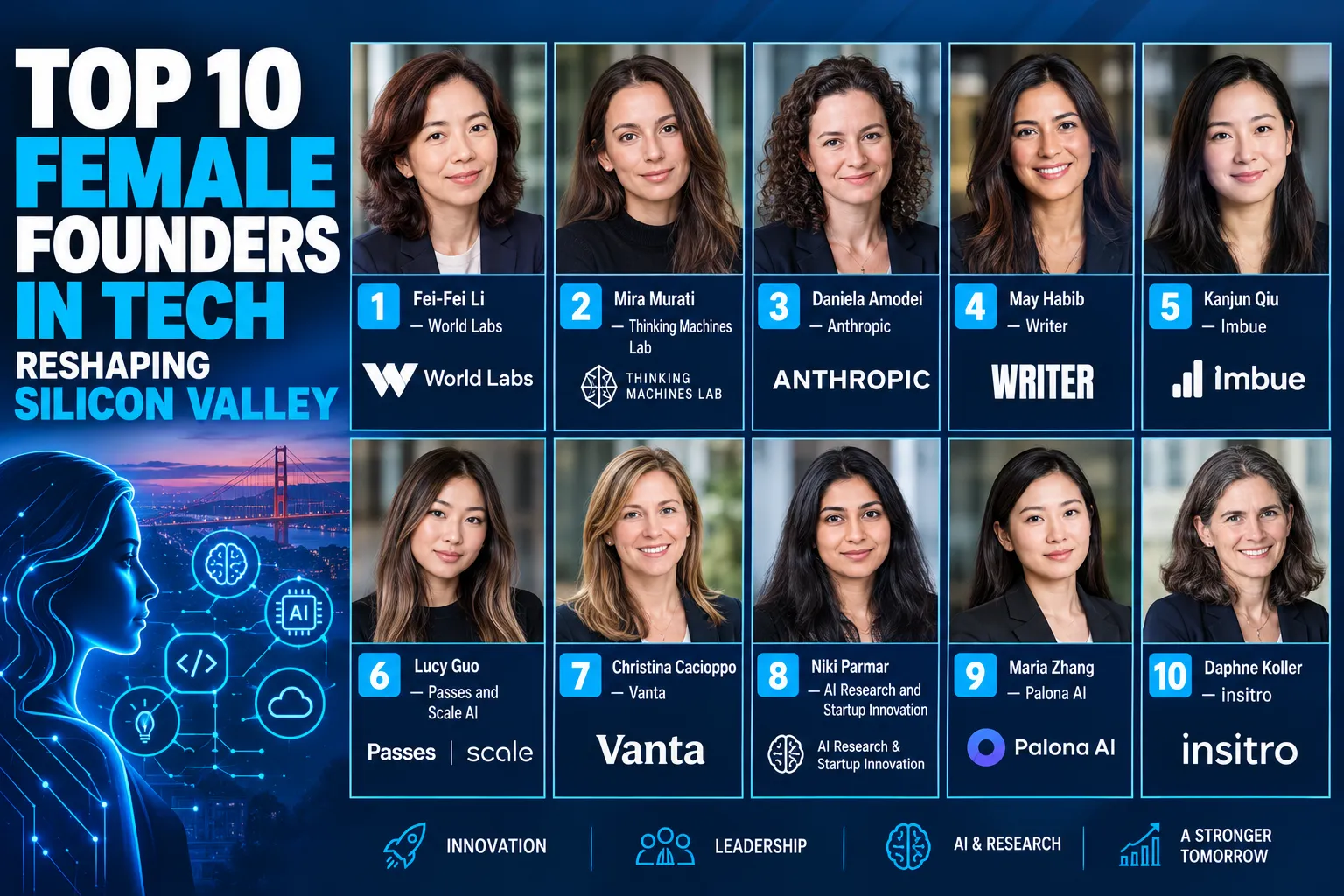
Silicon Valley has long been known for ambitious startups, groundbreaking software, and entrepreneurs who turn new ideas into influential businesses. Today, women founders are helping shape the region’s next chapter, particularly in artificial intelligence, enterprise software, cybersecurity, healthcare technology, and advanced computing.
These entrepreneurs are building companies that aim to solve complex problems. Some are developing AI systems that can support professional work, while others are making business software easier to use, improving cybersecurity, or applying machine learning to healthcare and scientific research.
Table of Contents
Resource Magainzes explore 10 female founders whose work is helping influence Silicon Valley’s technology ecosystem in 2026. The list includes both established entrepreneurs and founders building newer companies. It is an editorial selection based on their work and industry relevance, not a ranking by wealth, funding, or company valuation.
1. Fei-Fei Li – World Labs
Fei-Fei Li is a computer scientist, Stanford University professor, and co-founder of World Labs, an AI company focused on spatial intelligence.
Li is widely known for her contributions to computer vision and for helping advance ImageNet, a large visual dataset that played an important role in the development of modern image-recognition systems. Her academic work has helped shape how researchers train computers to interpret visual information.
With World Labs, Li is exploring a different challenge: developing AI systems that can understand and interact with three-dimensional environments rather than working only with text or flat images.
Spatial intelligence could help machines interpret physical spaces, understand relationships between objects, and generate representations of environments. These capabilities may have applications in robotics, design, simulation, and other fields where understanding the physical world is important.
2. Mira Murati – Thinking Machines Lab
Mira Murati is the founder of Thinking Machines Lab and the former chief technology officer of OpenAI. During her time at OpenAI, she held a senior role in the development and deployment of AI products, including systems that brought generative AI to a much wider audience.
After leaving OpenAI, Murati established Thinking Machines Lab to pursue further research and product development in artificial intelligence.
The company has focused on building AI systems designed to work more effectively with people, with an emphasis on adaptability and practical use. Its ambitions reflect a broader shift in the industry: moving beyond AI that simply responds to prompts toward systems that can support more complex tasks.
3. Daniela Amodei – Anthropic
Daniela Amodei is the co-founder and president of Anthropic, the company behind the Claude family of AI models.
Anthropic was established to research and develop advanced AI systems with an emphasis on reliability and responsible deployment. Its products are used for tasks such as writing, software development, research, analysis, and business productivity.
Amodei has helped lead the company’s organisational and commercial development as the demand for generative AI has expanded. Her work involves more than technology alone: building an AI company also requires teams, partnerships, customer relationships, and systems for managing risk.
4. May Habib – Writer
May Habib is the co-founder and CEO of Writer, an enterprise AI company that helps organisations develop and deploy AI applications for business workflows.
Many businesses want to use AI to improve productivity, but adopting the technology across an organisation can be complicated. Companies must consider their internal information, brand requirements, security standards, and existing software systems.
Writer focuses on enterprise applications that help teams create content, automate work, and develop AI-powered processes suited to their business needs.
Habib’s work reflects the growing demand for AI tools that can be integrated into everyday operations rather than used only for individual experiments.
5. Kanjun Qiu – Imbue
Kanjun Qiu is the co-founder and CEO of Imbue, a company exploring AI systems designed for reasoning, coding, and more complex forms of work.
Qiu’s background includes software engineering and experience working with technology teams. She also co-founded Sourceress, an earlier startup focused on recruiting technology, before turning her attention toward more advanced AI systems.
Imbue’s work reflects interest in AI agents: systems designed to carry out sequences of tasks rather than simply produce a single answer.
For example, an AI agent might need to understand a goal, break it into smaller steps, use software tools, check its progress, and adjust when something goes wrong. Developing systems that can perform these tasks reliably remains a major technical challenge.
6. Lucy Guo – Passes and Scale AI
Lucy Guo is a technology entrepreneur known for co-founding Scale AI and later launching Passes.
Scale AI developed services that help organisations prepare, evaluate, and manage data used in AI development. High-quality data and evaluation processes are important for training and assessing machine-learning systems, making this infrastructure relevant to AI research and commercial deployment.
Guo later founded Passes, a platform focused on helping creators connect with their audiences and generate revenue through digital content and communities.
Her work spans two different parts of the technology ecosystem: infrastructure that supports AI development and tools that help creators build businesses online.
7. Christina Cacioppo – Vanta
Christina Cacioppo is the co-founder and CEO of Vanta, a software company that helps businesses manage security compliance and demonstrate that they meet relevant standards.
For many technology companies, security certification can involve gathering documentation, reviewing internal processes, checking controls, and coordinating evidence across teams. These tasks can become time-consuming as a business grows.
Vanta developed software to automate parts of this process and help companies monitor their security posture. Its products support organisations working toward standards and frameworks such as SOC 2 and ISO 27001.
The company’s business addresses a challenge that has become increasingly important as businesses rely on cloud software and exchange sensitive information with third parties.
8. Niki Parmar – AI Research and Startup Innovation
Niki Parmar is an AI researcher and entrepreneur whose work has included co-founding Adept AI and Essential AI.
Parmar is known for her contributions to machine learning research, including work associated with the transformer architecture. Transformers became a foundational technology behind many modern language models and other AI systems.
Her career connects academic research with the challenge of building companies around emerging technology. AI research can produce promising techniques, but turning those techniques into useful products requires engineering, experimentation, customer understanding, and commercial execution.
9. Maria Zhang – Palona AI
Maria Zhang is the co-founder and CEO of Palona AI, a company developing AI-powered sales and customer-interaction tools for consumer-facing businesses.
Zhang has experience in software engineering and technology leadership, including roles at major technology companies. Her background reflects the value of understanding how software systems are built and how products can be designed for practical business use.
Palona AI focuses on helping businesses improve customer interactions through AI agents. Such tools may support activities such as answering customer questions, assisting with product discovery, and helping businesses deliver more personalised service.
10. Daphne Koller – insitro
Daphne Koller is a computer scientist, entrepreneur, and co-founder of insitro, a company that applies machine learning and biological research to drug discovery and development.
Before founding insitro, Koller co-founded Coursera, the online learning platform that helped expand access to courses from universities and other educational institutions.
Her work at insitro brings AI into a different field: understanding biology and identifying potential approaches to developing new medicines.
Drug discovery is complex, expensive, and uncertain. Researchers need to study biological processes, identify promising targets, evaluate compounds, and test whether a potential treatment is safe and effective. Machine learning can help researchers analyse large datasets and explore patterns that might otherwise be difficult to detect.
What These Female Tech Founders Matters?
Many technology companies begin with a specific problem. Vanta aims to simplify security compliance, Writer focuses on enterprise AI workflows, and insitro applies machine learning to challenges in drug discovery. Technical expertise can help founders understand what is possible, but a viable business also needs customers, pricing, operations, and a clear market strategy.
Founders must bridge the gap between a promising technical idea and a product people can use and are willing to pay for.
A product designed for enterprise compliance has different requirements from a tool used by a creator or a researcher. Successful founders need to understand their customers’ problems, working habits, budgets, and expectations. That knowledge helps them make better product and business decisions.
Enjoyed this list? Resource Magazines brings you more stories on the founders shaping the future of tech.