

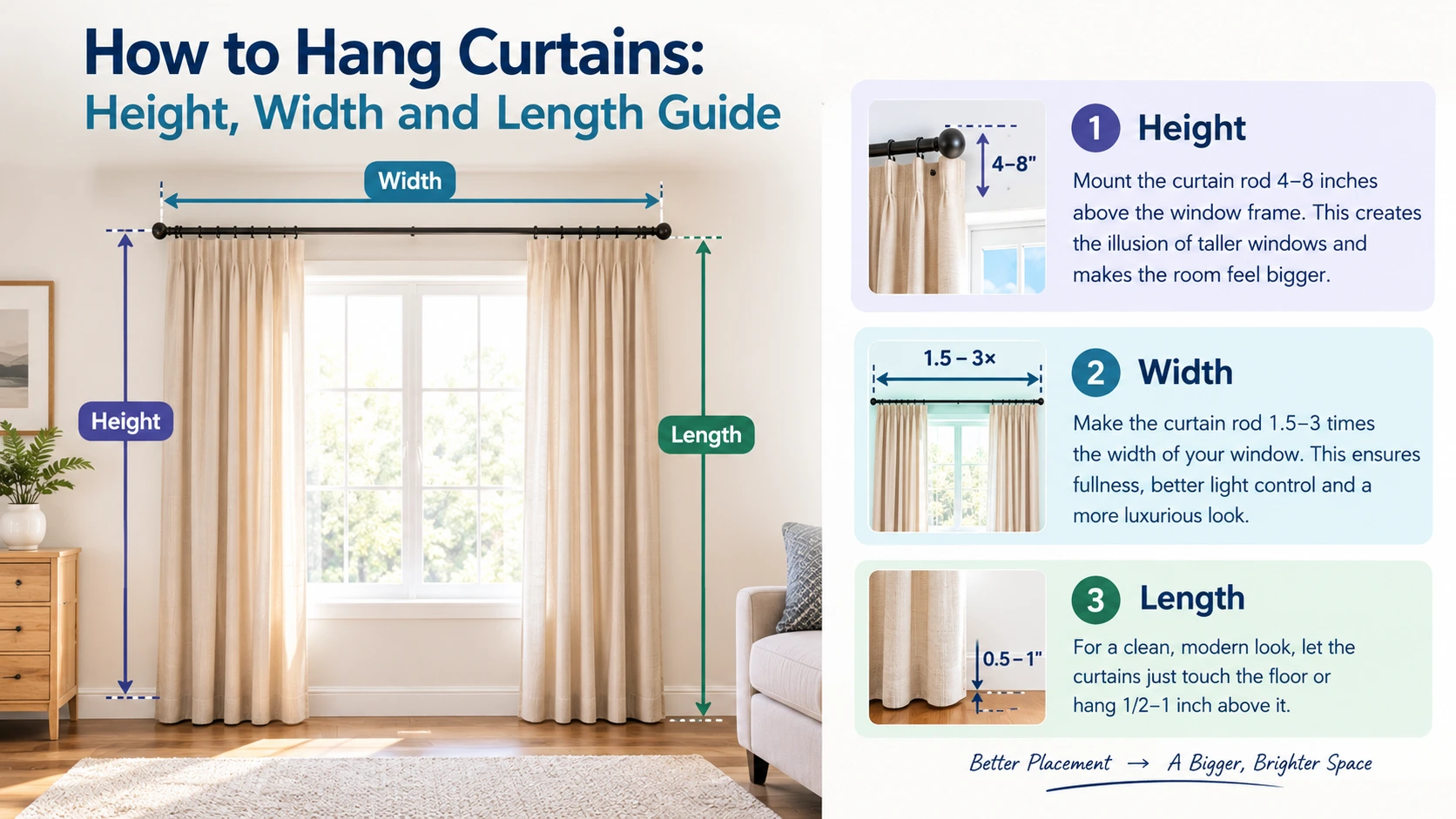
Most hang curtains look wrong for the same three reasons: the rod is too low, too narrow, or the panels are too skimpy. Fix those three measurements and even inexpensive curtains look tailored. Here are the numbers designers and major retailers use, with a worked example you can copy.
The cheat sheet
| Measurement | Rule of thumb | Why it works |
| Rod height | 4 to 6 inches above the top of the window frame | Makes the window and the ceiling look taller |
| Rod width | Extends 3 to 6 inches past each side of the frame | Makes the window look wider and lets the curtains clear the glass when open |
| Panel fullness | Total panel width of 2 to 2.5 times the rod width | Creates soft folds instead of a flat, stretched look |
| Length | Floor length, either just touching or hovering about half an inch above | Looks intentional and elongates the wall |
These ranges agree across guides from Wayfair, Crate & Barrel and Apartment Therapy. Wayfair adds that you can go 6 to 12 inches above the frame if you want the room to feel even taller.
A worked example
Say your window is 60 inches wide, and the top of its frame sits 80 inches from the floor.
| Step | Calculation | Result |
| Rod height | 80 inches + 4 to 6 inches | Mount the rod 84 to 86 inches from the floor |
| Rod width | 60 inches + 4 inches on each side | A rod about 68 inches wide |
| Total panel width | 68 inches x 2 to 2.5 | 136 to 170 inches, split across two panels |
| Panel length | Rod height minus about half an inch of floor clearance | Subtract the drop of your rings or hooks before buying |
Measure each window yourself rather than assuming they match. Panels commonly range from about 63 to 120 inches long, so you will usually need to buy to your measurement, not the other way round.
How to hang them: 7 steps
- Measure and mark the height. Measure from the floor to the top of the window frame, then mark 4 to 6 inches above it.
- Mark the width. Measure out from the edge of the frame on both sides and mark where each bracket will go.
- Level the marks. Use a level so the rod does not slope, and use a paper template if you have several windows so every rod sits at the same height.
- Drill pilot holes. A small pilot hole helps stop the drywall paper from tearing.
- Fix the brackets. Use wall anchors if you are not hitting a stud, especially for a heavy rod and lined curtains.
- Add the rod and the curtains. Thread rings or slide the rod pocket on before you lift the rod into place.
- Adjust the fall. Step back, smooth the folds, and check the hem just clears the floor.
Special cases
- Low ceilings. If there is little space above the window, aim for 4 to 6 inches above the trim, but keep at least 2 inches between the rod and the ceiling, as TaskRabbit recommends.
- Small windows. Hang the rod higher and wider than normal so the window reads as larger.
- Mounting inside the frame. This uses less fabric and shows off decorative molding. Mount outside the frame if the frame looks plain or you want to cover it.
Do and don’t
| Do | Don’t |
| Hang the rod above and beyond the window frame | Mount it right on the frame |
| Buy panels wide enough to look full when closed | Buy panels that only just cover the glass |
| Choose floor-length panels | Leave a gap of several inches above the floor |
| Level every rod and use anchors | Eyeball the height and rely on thin screws alone |
Quick questions
Should curtains touch the floor?
Either just touching or hovering about half an inch above looks tidy. Letting them pool on the floor is a deliberate, more formal choice.
How wide should the rod be?
About 8 to 12 inches wider than the window, which is 4 to 6 inches on each side.
Can I hang curtains higher than 6 inches above the window?
Yes. Many guides suggest going higher when the ceiling allows, since it makes the room look taller.